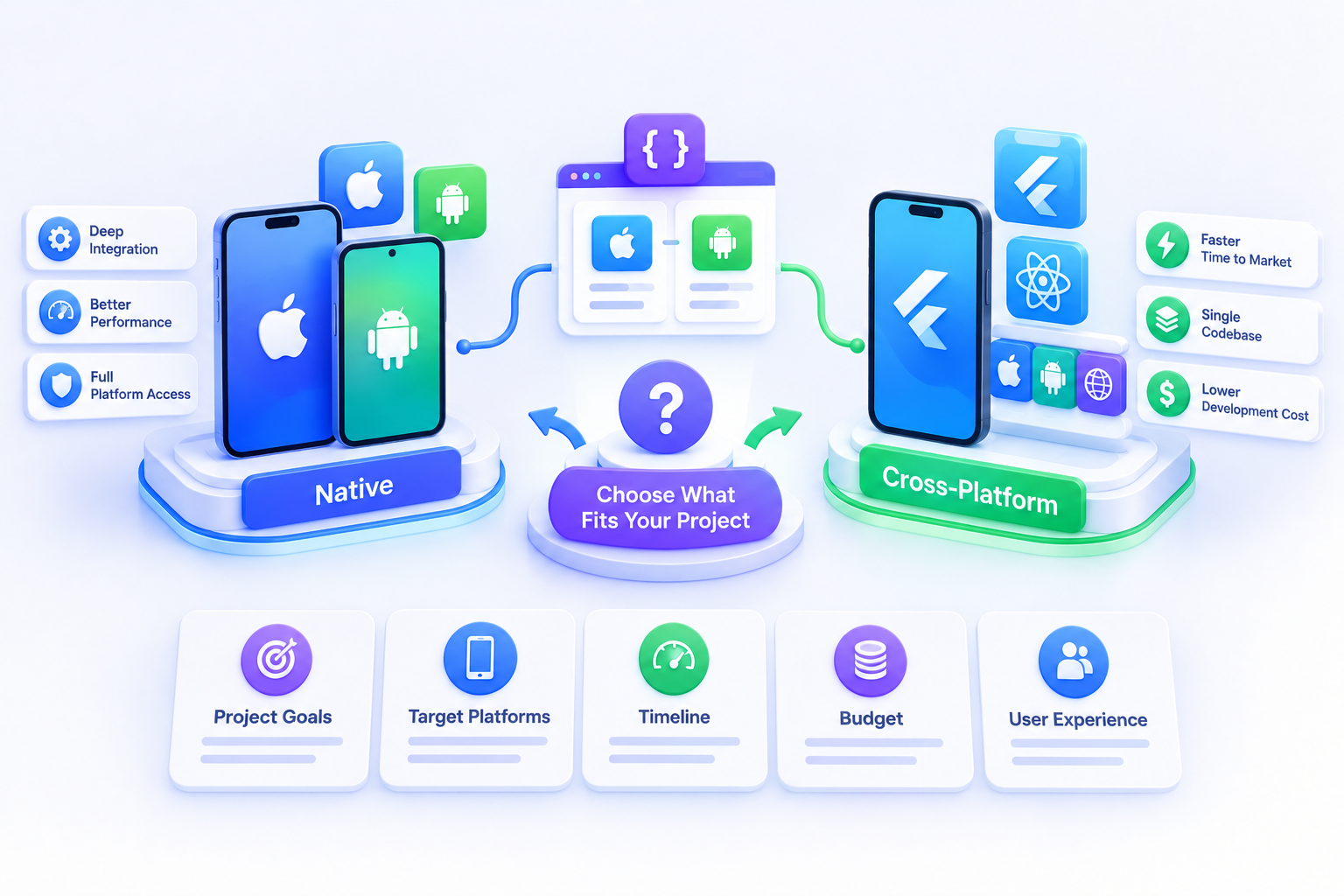
- Market velocity: Cross-platform frameworks like Flutter reduce initial engineering time-to-market by 35% to 45% for MVPs and product launches.
- The 120Hz ProMotion reality: Native Swift (SwiftUI) and Kotlin (Jetpack Compose) remain unmatched for complex gesture physics, real-time audio/video processing, and AR/sensor access.
- Team economy: Maintaining two native codebases requires twin specialized teams; single-codebase Flutter lets a lean team iterate simultaneously on iOS, Android, and web.
- The Decision Rubric: If your app is primarily API-driven data display, choose Flutter. If your app relies on Bluetooth LE telemetry, custom camera filters, or background location geofencing, build native.
Beyond the Fanaticism: A Pragmatic View
Every year, the tech industry undergoes intense religious arguments regarding mobile app architecture. Cross-platform advocates claim native development is dead; native purists claim cross-platform apps feel sluggish and counterfeit.
At Dazora Tech, our engineers build production apps in both paradigms. We do not have a dog in the fight — our sole fiduciary duty to our clients is recommending the stack that maximizes business velocity while protecting against architectural dead ends.
1. The Evolution of Cross-Platform in 2026
The cross-platform landscape of 2026 is unrecognizable compared to the clunky web-view wrappers (like Cordova or PhoneGap) of a decade ago. Today, Google's Flutter compiles ahead-of-time (AOT) directly into native ARM machine code, bypassing browser engines entirely.
With its Skia and Impeller rendering engines, Flutter draws every single pixel directly onto the GPU canvas. This guarantees pixel-perfect visual consistency across iPhone, Samsung Galaxy, and Google Pixel devices.
| Evaluation Vector | Native (Swift / Kotlin) | Cross-Platform (Flutter) | When to Prefer |
|---|---|---|---|
| Time to Market | Dual Sprints (2x delivery cycles) | Single Sprint (1.3x delivery cycle) | Flutter for rapid MVP launch |
| Development Cost | Higher (requires iOS + Android devs) | 30% - 40% Lower overall budget | Flutter for capital efficiency |
| Hardware API Access | Instant Day-1 support for new OS APIs | Relies on third-party bridge plugins | Native for Bluetooth / HealthKit |
| UI Consistency | Adheres strictly to Apple / Google HIG | Custom branded UI identical on both | Flutter for branded design systems |
| Binary Bundle Size | 12 MB - 25 MB | 28 MB - 45 MB | Native for emerging market limits |
2. When Native Swift & Kotlin Are Irreplaceable
Despite Flutter's immense strengths, there is a distinct category of digital products where attempting cross-platform development is a strategic mistake:
- Intensive background telematics: Logistics tracking apps that must wake up GPS chips every 15 seconds while the phone screen is locked. Android battery optimization (Doze mode) and iOS background execution policies require granular OS-native lifecycle hooks.
- Bluetooth Low Energy (BLE) peripheral hardware: Medical clinic devices, IoT sensors, and wearable firmware syncing. Writing custom platform channel bridges in Flutter often negates any time saved.
- Audio/Video real-time codecs: Custom video rendering pipelines, low-latency audio processing, or augmented reality (ARKit / ARCore).
3. Real-World Case Studies from the Studio
Case A: Cross-Border Delivery Platform (Flutter)
A regional logistics and parcel delivery client needed customer-facing apps on both iOS and Android within 90 days. Choosing Flutter allowed our team of three engineers to deliver complete barcode scanning, live parcel tracking, and multi-currency checkout on both platforms simultaneously, beating their launch deadline by 12 days.
Case B: Clinic Telemetry & Vitals Monitor (Native iOS & Android)
A healthcare client required an app that paired via Bluetooth with digital blood pressure monitors and continuous glucose monitors. Because signal stability and zero-lag background data ingestion were mission-critical for patient safety, we engineered native Swift (CoreBluetooth) and native Kotlin (Android BLE) applications.