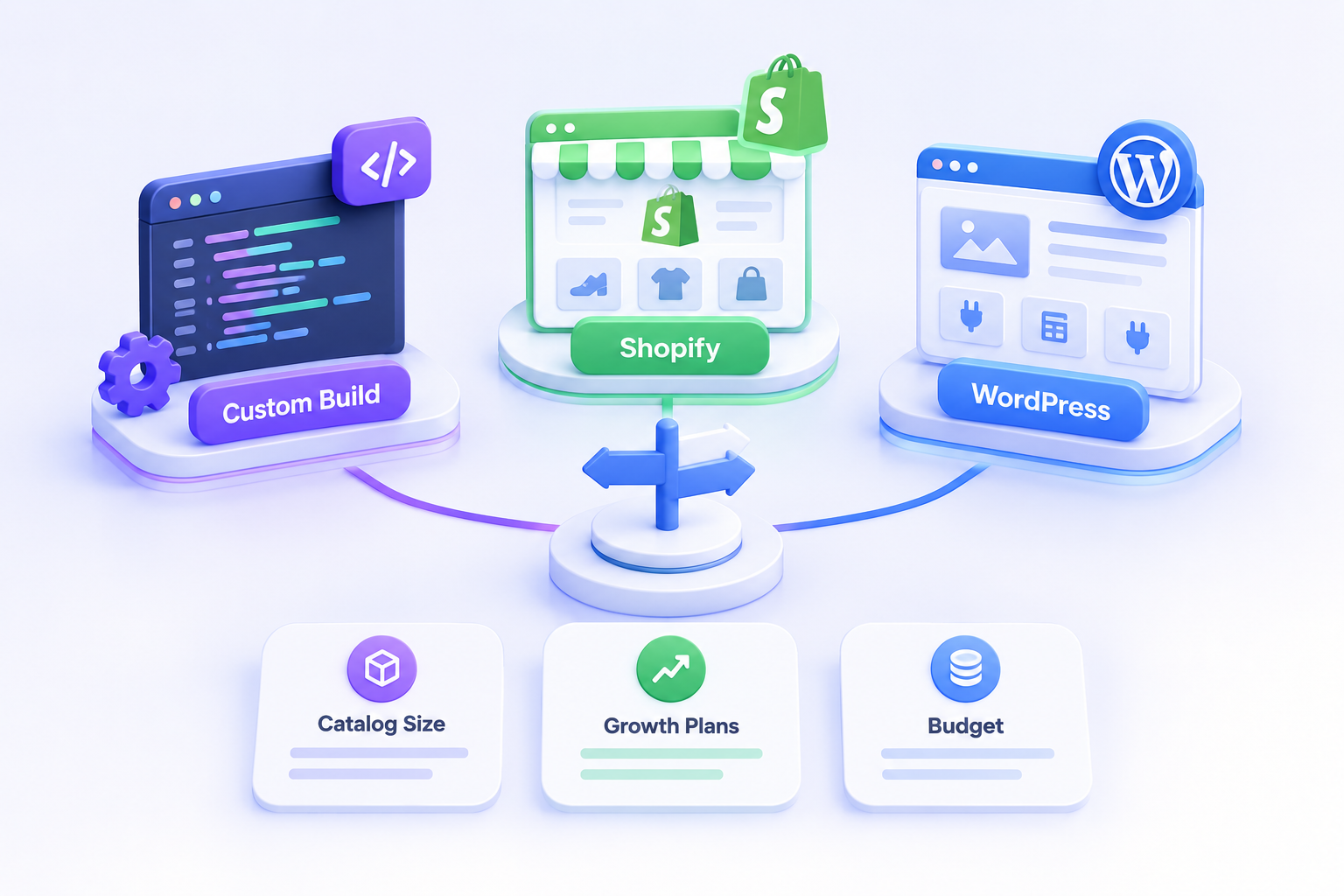
- The Shopify Tax: While Shopify starts at $39/month, app subscriptions, transaction percentages, and custom checkout lockouts (requiring $2,500/mo Shopify Plus) drastically inflate long-term spend.
- WooCommerce limits: WordPress with WooCommerce works well for under 500 SKUs, but struggles with database contention during concurrent flash sales.
- Custom Headless superiority: For businesses with complex B2B pricing, wholesale customer tiers, or localized emerging-market payment gateways, custom Next.js/Node platforms deliver superior margins.
- Selection rubric: Standard retail D2C? Choose Shopify. Content-heavy brand with merchandise? WooCommerce. Scaling enterprise or multi-vendor marketplace? Build custom.
The Platform Decision That Makes or Breaks Margins
Every growing retail and wholesale enterprise reaches a crossroads: which software foundation should host our commercial engine? Make the right choice, and your e-commerce platform becomes an invisible growth multiplier. Make the wrong choice, and you will spend hundreds of hours fighting platform constraints and paying exorbitant transaction taxes.
At Dazora Tech, we build and scale stores across all three models. Here is an unfiltered, honest engineering breakdown of the trade-offs.
1. Shopify: The Turnkey Heavyweight
Shopify is the gold standard for standard Direct-to-Consumer (D2C) brands that want a reliable checkout hosted on resilient global infrastructure without managing servers. Security, PCI-DSS compliance, and Apple Pay integrations are handled effortlessly.
However, the hidden trade-offs become painful as your sales volume climbs:
- The "App Stack" Tax: You will inevitably need third-party apps for recurring subscriptions, volume tier discounts, product bundling, and shipping rules. It is common for a store to accumulate $300 to $900 per month in SaaS app fees alone.
- Checkout Lockout: Unless you upgrade to Shopify Plus ($2,500+ per month), you cannot touch or customize the checkout flow. Adding custom B2B fields or custom payment gateway logic is mathematically impossible.
- Platform Lock-in: Exporting customer passwords or complex database schemas out of Shopify is heavily restricted.
| Architecture Dimension | Shopify | WooCommerce (WP) | Custom Headless (Dazora) |
|---|---|---|---|
| Time to Launch | 1 - 3 Weeks (Fastest) | 2 - 5 Weeks | 6 - 10 Weeks (Bespoke) |
| Checkout Customization | Locked (Shopify Plus required) | 100% Modifiable via PHP | Infinite flexibility (React / Next.js) |
| Transaction Fees | 0.5% - 2.0% unless Shopify Payments | 0% Platform Fee | 0% Platform Fee |
| High-Concurrency Scaling | Effortless (Managed Cloud) | Requires heavy Redis / DB tuning | Sub-second edge static distribution |
| B2B & Tiered Pricing | Expensive add-ons / Plus required | Supported via plugins | Built natively into core business logic |
2. WooCommerce: Total Ownership, Moderate Scale
WooCommerce powers over 23% of the world's top one million online stores. Its principal advantage is complete sovereignty: you own the code, the database, and the customer records. There are zero platform transaction percentages.
Where does WooCommerce struggle? Database concurrency during flash sales. Because WordPress stores order data and order metadata across normalized SQL tables (`wp_posts` and `wp_postmeta`), running a flash sale with 1,000 shoppers adding items to their carts simultaneously can cause database row locks, resulting in sluggish 6-second checkout load times.
3. Custom Build: When Uniqueness Is Your Competitive Advantage
Building a custom e-commerce solution using modern stacks (Next.js, Node.js, PostgreSQL, Stripe/local payment APIs) is not for every business. But for specific enterprises, it is the only viable path:
- Complex B2B Wholesale: Custom credit lines, net-30 terms, tiered wholesale pricing based on contract tiers, and multi-location employee purchasing permissions.
- Custom Product Configurators: Interactive 3D garment customization, custom machinery sizing, or dynamic bundle pricing that standard e-commerce platforms cannot calculate.
- International Emerging Markets: Direct integration with regional fintech providers, COD (Cash on Delivery) verification via WhatsApp, and zero foreign exchange penalties.
4. 3-Year Total Cost of Ownership (TCO) Reality Check
Consider a retail brand doing $2,500,000 in annual gross sales:
- Shopify Plus Route: $2,500/mo platform fee ($90k) + $450/mo apps ($16.2k) + transaction take rates = ~$135,000+ across three years.
- Custom Dazora Build: $28,000 one-time engineering build + $180/mo cloud hosting infrastructure ($6.5k) + annual maintenance = ~$48,000 across three years.
The business saves over $87,000 in operational capital while owning an asset that can never be turned off or altered by a third-party platform provider.