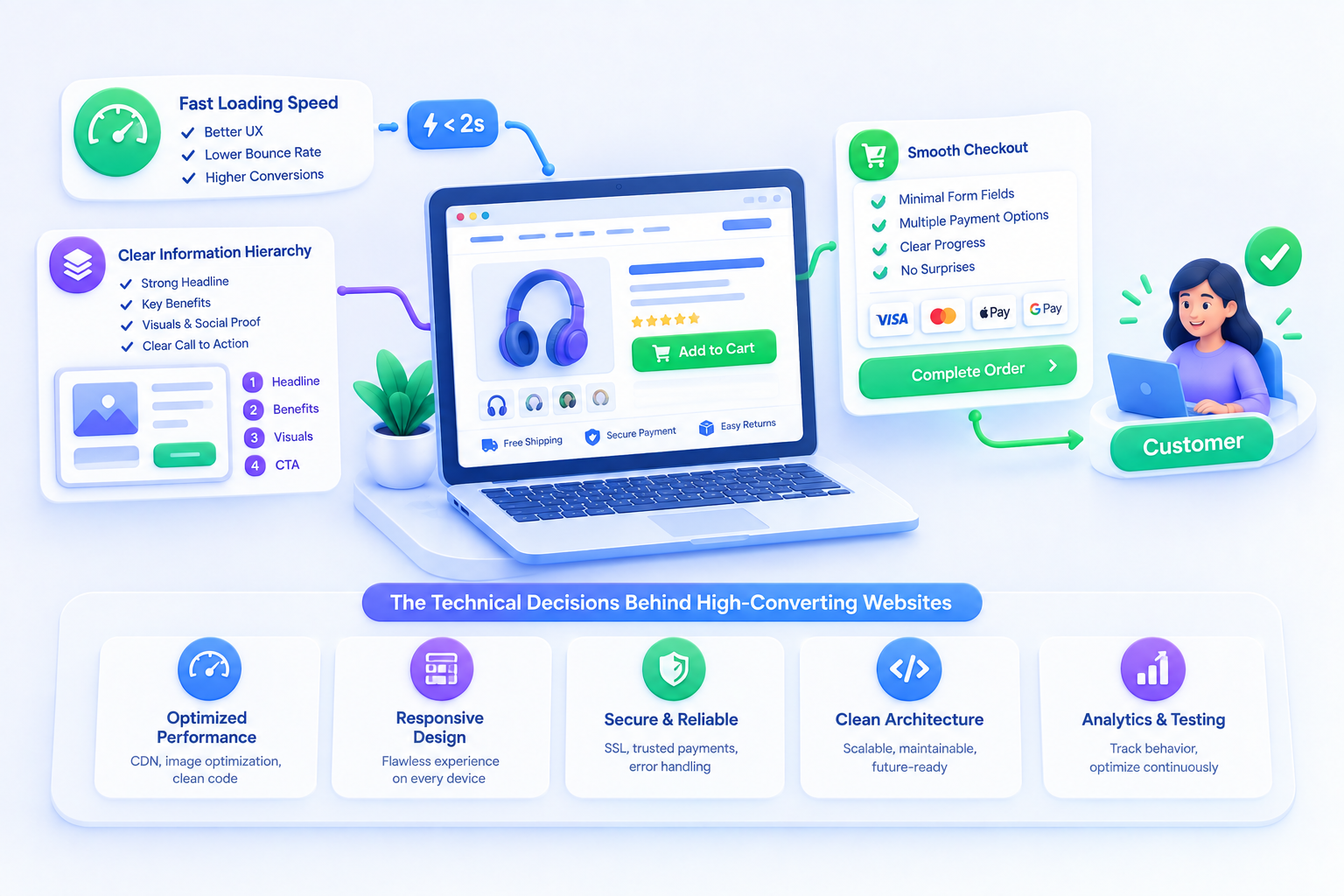
- The 1.2-second threshold: Every 100ms delay in page response beyond 1.2s reduces enterprise conversion rates by an average of 7.4%.
- Cognitive friction kills deals: Complex navigation, redundant form fields, and vague value propositions cause 68% of commercial bounces.
- Architectural superiority: Static generation and edge-rendered head-less setups consistently outperform monolithic theme templates.
- High-trust micro-interactions: Verifiable security tokens, instant WhatsApp/phone fallbacks, and transparent shipping calculators remove friction before checkout.
The Myth of the "Pretty Website"
Over the past four years at Dazora Tech, we have audited more than 250 commercial websites across North America, Europe, and the Middle East. The single most persistent misconception business founders hold is that a website converts because of flashy visual aesthetics.
In reality, high-converting websites are not art exhibits — they are precision-engineered decision engines. When a potential buyer arrives on your landing page, their subconscious mind is assessing three fundamental variables within the first 800 milliseconds:
- Am I in the right place? (Instant value proposition clarity).
- Can I trust these people? (Proof of capability, security signals, clean engineering).
- What is the next frictionless step? (Unambiguous call-to-action).
1. Core Web Vitals: The 1.2-Second Rule
You cannot convert a visitor who leaves before your hero banner paints. In 2026, user patience on mobile devices has reached an all-time low. Modern analytics reveal that 53% of mobile visits are abandoned if load times exceed 2.4 seconds.
| Page Load Time (LCP) | Average Bounce Rate | Relative Conversion Index | Technical Bottleneck |
|---|---|---|---|
| Under 1.0s | 18.2% | 100% (Baseline Peak) | Edge Cached / Clean Static HTML |
| 1.5s - 2.2s | 34.8% | 78% (-22% revenue) | Unoptimized 2MB+ Hero Images |
| 3.0s - 4.5s | 58.1% | 42% (-58% revenue) | Heavy Third-Party Tracking Scripts |
| 5.0s+ | 81.4% | 14% (-86% revenue) | Bloated Page Builder Plugins |
To hit the coveted sub-second mark, we eliminate client-side JavaScript rendering cascades. Assets are pre-compressed with modern WebP/AVIF formats, fonts are pre-connected, and critical CSS is injected inline to prevent layout shifts (CLS).
2. Visual Hierarchy and the F-Pattern Scan
Eye-tracking studies consistently confirm that business decision-makers do not read web pages like books. They scan in an F-pattern: scanning the top horizontal bar, dropping down to read sub-headings, and scanning bulleted lists for relevant keywords.
When design teams clutter the hero screen with rotating carousels, autoplaying videos without captions, or walls of marketing buzzwords, conversion rates plummet. The winning formula requires ruthless subtraction:
- A single H1 headline: State exactly what you do and for whom, without vague metaphors.
- A secondary supporting statement: Provide the quantifiable proof or timeframe (e.g., "Deployed in 14 days, backed by 24/7 SLA").
- One primary action button: Give it high contrast against the background so the user's eye naturally gravitates toward it.
- Secondary escape route: For users who aren't ready to buy yet, provide a low-friction action like "View Case Studies" or "Chat on WhatsApp".
3. The Architecture of High-Trust Social Proof
Generic quotes like "Great service! - John D." do not build trust in 2026. B2B buyers and discerning consumers require verifiable proof points. Our highest-converting client websites implement proof through structured proof anchors:
- Hard metrics: Replace "We help companies scale" with "Reduced manual dispatch hours by 52% for 14 fleet operators."
- Recognizable client lockups: High-contrast partner logos and third-party verified ratings.
- Face and credentials: Author avatars, direct engineering leads, and transparent physical company addresses.
4. Friction-Free Checkout and Zero-Stall Inquiry Funnels
Every unnecessary field on a lead form or checkout flow degrades conversions by an estimated 11%. If your contact form asks for "Fax Number", "Company Size", and "Annual Revenue" on step one, you are throwing away warm leads.
At Dazora Tech, we engineer progressive disclosure forms: capture only the email or WhatsApp number first, then dynamically unlock deeper questions once the user has taken micro-commitment actions.
5. Client Vignette: 184% Conversion Lift
In Q3 2025, an industrial procurement platform operating on a legacy WordPress setup approached Dazora Tech. Their pages took 4.2 seconds to load on 4G networks, and their lead submission rate had hovered around 1.1% for eighteen months.
We completely overhauled their frontend using a bespoke lightweight architecture, compressed their media pipeline, introduced one-click WhatsApp inquiries, and simplified their 9-field quote form into a streamlined 2-step wizard. Within 60 days of launch:
- Mobile page load speed dropped from 4.2s to 0.85s.
- Bounce rate plummeted from 64% to 26%.
- Monthly qualified quote inquiries grew by 184% without increasing their ad spend.